Making Things Better: Lessons learned in the trenches, shared to help you strengthen your discipline muscles.
Over my career, I’ve seen many people who wanted to be paid well and had very impressive experience on paper, but I’ve had to put them on performance plans and even let them go. It sounds harsh, but at the end of the day, they lacked the discipline to do the core things required of a project manager. Having the greatest soft skills in the world while remaining inconsistent with the core parts of project management still doesn’t cut the mustard.
Discipline beats experience and degrees every single time.
What Discipline Means for Project Management: Do the Standard and Basic Stuff
Discipline is not complicated. It is consistently doing the things that need to be done, even when they are boring, repetitive, or full of obstacles.
It’s doing the unglamorous work that keeps a project on the rails, like the status reports, maintaining schedules, RAID log, relentless follow-ups, and documentation. Action items and status tracking might not be exciting, but they are a massive part of the job. Discipline means doing those things before they become urgent, and staying consistent even when it’s tempting to let things slide.
I have recent personal experience about discipline that directly applies to project management.
Not long ago, I was diagnosed with a severe case of diabetes. I found a naturopathic doctor who works with patients to treat it naturally. He told me upfront: “Sometimes it works and sometimes it doesn’t, but the biggest determining factor is discipline.”
He put me on a rigorous plan that involved an extreme diet, heavy gym work, herbal supplements, acupuncture, and stress reduction. I decided right then to execute it without wavering:
I follow the extreme diet with zero excuses.
I show up to the gym four days a week at 5:00 AM.
I haven’t missed a single supplement or acupuncture session.
After seven weeks of strict rigor, my doctor told me I earned an A+ because he rarely sees people actually follow the plan this well. My 24-hour glucose average dropped from 330 down to 175. I’m not out of the woods yet, but the improvement came because of discipline.
The story of the picture below is that I had emergency ankle surgery two years prior. During a visit with the surgeon as I started PT, I asked how long before I can run a half marathon. The Dr. said NO more running. I responded and said “there is only one problem with that. My last memory of half marathons is not going to be your surgery table”. There was a bit of silence and an eye opening reaction. Then the Doc said “Ok. Just one more.” After 1 ½ years of weekly physical therapy and consistent training, that is a pic of me crossing the finish line with the upgrades of a plate, 7 screws, and two bolts/ties for my final half marathon. I look happy in the picture because I made it, but what got me to that point of hanging my last neck trophy was the 1 ½ years of discipline.
Project management operates the exact same way. You can have the best methodology or plan on paper, but if you don’t have the discipline to execute the daily rigor, you won’t see results.
The Tangible Advantages of Discipline
In my career, I’ve led, directed, and managed about five PMOs through countless challenging situations. While some of those situations required soft skills and judgment calls, the majority of project failures were purely tactical. People simply NOT getting things done or lacking discipline.
When you make discipline your strong point, the benefits build rapidly:

● Discipline creates trust: People know you will do what you say you will do, so they stop worrying about following up with you.
● Good PMs don’t need to be chased down: If your manager has to remind you of the fundamentals, your manager is partially doing your job for you.
● Discipline beats talent: You can be the smartest PM in the room, but if you don’t follow through, people stop depending on you.
● Discipline reduces surprises: Executives can handle bad news, but what they can’t handle is bad news they should have known about a month ago.
● Discipline and soft skills work together: Soft skills help you have a difficult conversation. Discipline makes sure you actually have the conversation AND that you bring the data to back it up.
● Discipline requires ownership: Saying “the client didn’t respond” explains what happened, but it doesn’t explain what you did about it. Lack of discipline creates hidden work for everyone else until it eventually becomes someone else’s problem, which at that point means you become the problem.
Real Talk Based on 37+ Years in the Trenches
Throughout my career in project management, I’ve had the blessing, and the curse, of special assignments, saving accounts, and turning around troubled clients for over 37 years. From my early career all the way to today, as I prepare to retire in a few years, I’m still assigned to difficult situations and clients.
There’s a well-known quote that captures a cycle of human nature that also plays out in business:
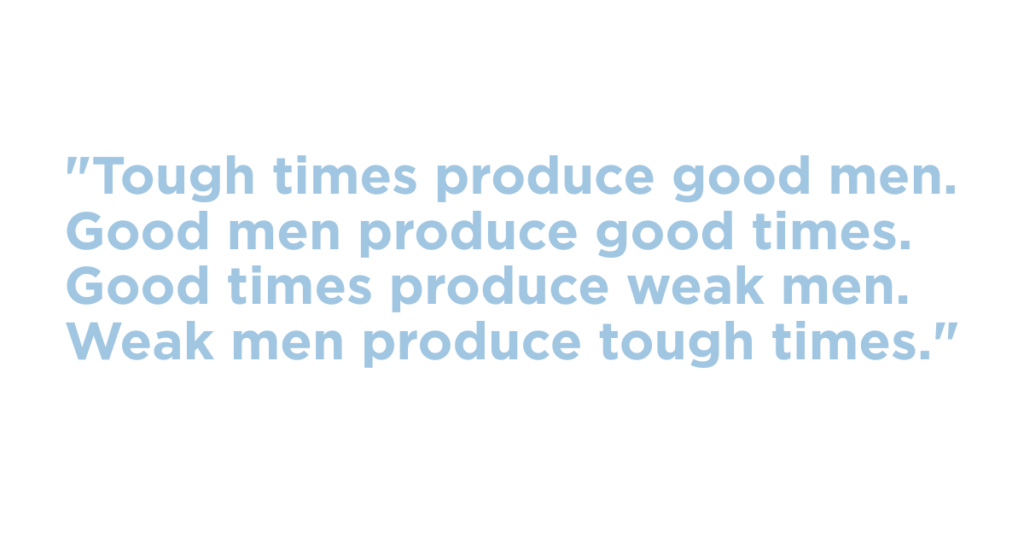
In project management, when budgets are flush, deadlines feel distant, and the client is happy, it’s easy to let your discipline slip. We stop updating the risk logs, we skip the follow-up notes, and we let the mundane fundamental habits slide. But abandoning discipline during the good times is precisely what creates the tough times down the line. Maintaining rigor when things are going smoothly protects you, your team, and your organization from creating self-inflicted crises in the future.
I started in project management before I even had a college degree. Many times early on, I was in rooms with people who were smarter than me and had far more experience. I later earned my degree and built up my knowledge, but what kept me in the room and assigned to those critical accounts was the discipline of finishing the job.
Early in my career, someone with a master’s degree and years of experience who was looking for work looked at my resume and said, “I wish I had your resume.” They pointed out that many people with advanced degrees would love my client list, my experience, and my lack of gaps. I understand some of that was being in the right place at the right time and opportunities and people around me.
However, I took some pride in that and asked myself why my path looked like that. The answer, I believe, is that my reputation for discipline and getting things done was a big part of the why..
If I’m going to promote someone, it isn’t because they are nice, or because of their background, or any physical traits. Promotion comes to those who are disciplined. The best PMs develop a reputation where leaders say, “Give it to them. They’ll get it done.” That reputation is worth more than a PMP, or any credential, because it’s a career insurance policy.
Develop the Discipline That Outperforms PMP Certification
You don’t have to be the smartest project manager in the room. You don’t have to have the most experience, and you don’t need the shiniest degree hanging on the wall. While those things have value and I’m an advocate for the PMP, none of them matter if you can’t execute.
What matters is developing the discipline to consistently do the things that need to be done. People will notice. And when things get difficult, those are the exact people organizations want in the room to get ‘er done.
Until next time, keep making things better.
James McCoy